Aug 12 2010

Tone Nirvana: Fact or Fiction.

BrianG

Musicians can debate which band or which guitar player/drummer/bassist is the greatest of all time, but the one thing we can all agree on is the universal quest for perfect tone.  Of course that means something different for everyone, but all of us can relate to the quest.  After many years of playing, and searching, I began to think “tone nirvana” was just an illusion.  An unquenchable desire that would never be satisfied or complete.  I had begun to believe that it was just a quest.

However, an encounter I had with a brilliant pedal designer just last week changed all that.  I had heard some good things about the JHS pulp’n’peel compressor and thought I’d give it a try.  I typically hate compressors; I hated the compressor I was using.  While smoothing out the signal, even the best compressors squash the attack so much that it sounds canned and over processed.  Not my thing.  So off I go to meet with Joshua Scott, owner/creator of JHS pedals.

The first thing I notice when I arrive at JHS are the similarities to Anthology.  JHS is set up in a small shop with pedals, guitars and amps everywhere.  It was clear when we talked, that Josh (who happens to be a really cool guy) and his crew love what they do. They are certified tone junkies. They’re not some giant manufacturer pumping out tons of mediocre boxes of noise; they are tone artists, dedicated to crafting hand made auditory perfection. There are so many pedals on the market that all basically do the same things they’ve been doing for years. And frankly, so much gear is just not made that well.  The JHS philosophy, like Anthology, is to build it the right way, and that means build it well, build it perfectly, and players will notice.

I noticed, as soon as we plugged in and began trying out the different pedals.  These are different.  I’ve been playing for a long, long time, and have gone through so many new, hot pieces of gear that hit the market. Without fail, I end up selling them all off.  Not going to happen with the JHS pedals, they have been super-glued to my board.  The second we plugged in, I was just blown away by the perfection of these little monsters. So transparent, so rich, and so responsive.  Even better, every pedal I tested was so flexible.  I’ve had so many well-regarded pedals that ended up being one-trick ponies. These pedals sounded amazing regardless of what sound I was trying to achieve.

It became clear early on that my board was going to change.  I couldn’t walk out of their without getting at least the basics of my board converted. In the end, I had to make a decision.  I walked out of there with the “Charlie Brown” channel drive for low to mid gain, the “Angry Charlie” channel drive for mid to high gain, the “Pulp’n’Peel” compressor and the “Mini-Bomb” clean boost.  Just four pedals, that have brought me closer than ever to tone nirvana.

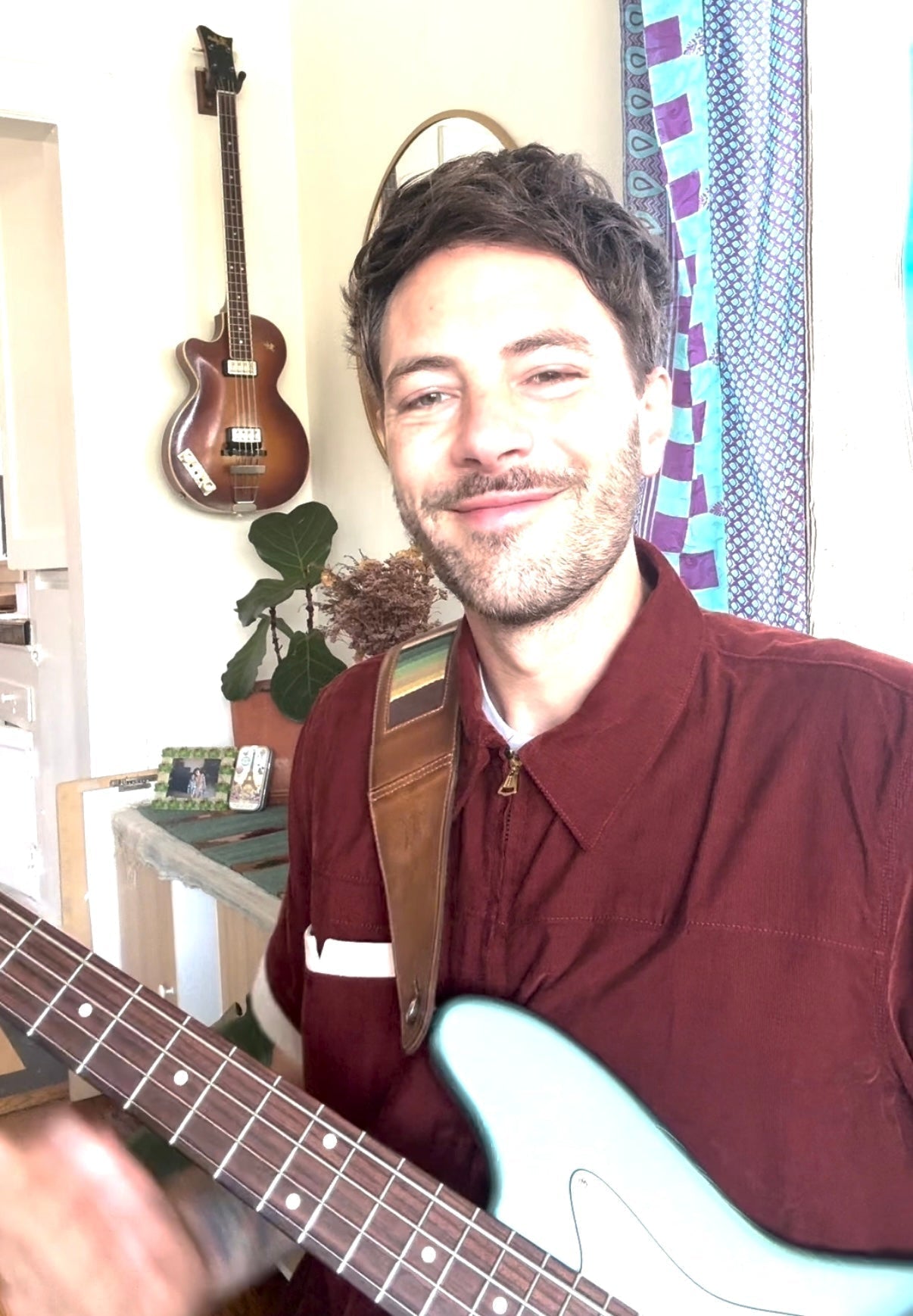
A quick look at my basic setup, including my new JHS pedals.

One final thought. I wish that web technology was further along, because the web videos on the JHS site (www.jhspedals.com) don’t do these bad boys justice at all.  You really need to plug in. If you can’t find them in your area yet, just go ahead and make the drive to KC, it’s worth it.


Jul 21 2010

Perfectionism and the Creative Process

BrianG

I’m the classic youngest child, type B personality, very laid back.  I’m not driven to climb any ladders, or conquer any mountains.  But I am driven.  What drives me is the desire to create great work, that stands on it’s own.  When it comes to creating great work, whether that’s designing a new strap, or songwriting, or executing a phenomenally improvised solo, I’m a die-hard perfectionist.  That has served me well to a large extent, mainly because people like myself appreciate things that are done well.  But, I’ve discovered recently that perfectionism has a dark side.

When it comes to songwriting, perfectionism can be your worst enemy.  It’s a natural part of the process of songwriting to evaluate what’s working and what’s not.  But where it can get derailed is when we over-think everything.  When making value judgments during the process, deciding whether it’s good, bad, cool, or brilliant can also be a noose that can keep you from finishing anything.  Especially if you focus on how it will be received.  Asking yourself “will people like this”, or “how will this song effect how people view me”, are the quickest ways to kill the creative process.  My sister, who is a prolific songwriter, and in her day was recording with giants like Carol King and the Eagles, once gave me a brilliant piece of advice.  She said, “You have to constantly write….in order to get 8 great songs, you need to write at least 25 good songs, and in order to get 25 good songs, you’ll write 100 average songs, it’s just part of the process.”

When it comes to improvising, it’s easy to listen to those live recordings from the “Baked Potato” in L.A. and be in awe at the guys who never miss a note, and whose improvised moments are “perfect.”  But I can promise you, that those guys aren’t supernatural.  They have all implemented a philosophy of taking chances early and often in their improvisational experiences.  Taking chances in improv means looking/sounding bad at times.  But over time, that pays off, big time.  If you implement the open philosophy of always taking chances and pushing your boundaries, those boundaries will grow, and you’ll find that you can execute the risks with more consistency.  Without taking chances, and risking sounding bad, you end up “in the box”, saying to yourself, “how can I break out of these ruts.”

The biggest obstacle to reaching the heights in any creative endeavor is the narcissism of perfectionism.  The more we have to be perfect to appeal to others, or to satisfy ourselves, the longer it will take us to reach the level of greatness we desire.  The irony that’s so hard to wrap our minds around is, in order to be great musicians or artists, we have to be willing to put all of ourselves out there on the line, and risk looking imperfect.


Jul 6 2010

Philosophy 201: Why I’ll never make a Hanna Montana guitar strap.

BrianG

I feel compelled to write this post only because several people have suggested I would make a killing making teen pop star themed guitar straps.  My initial response usually includes maniacal laughter, but then I feel bad and try to compose myself.  The topic gives me an opportunity to let you know who I am and where I’m coming from.

The truth is, I probably could make a killing making Hannah Montana straps.  I mean really, who just makes straps for guys obsessed with their gear, and who’ve seen the inside of a bar or bus more than they’ve seen the inside of their eyelids.  How many people actually buy boutique guitars, compared to how many buy lesser  guitars?  I could easily pump out more straps, make them really cheap and cover them with clip art patterns and glittery things that would be all the rage.  I would most definitely have a larger customer base.  But, that’s just not who I am.  I don’t like crap.  I don’t like cheap, poorly made guitars, amps, pedals, or even cheap faux-meat cheeseburgers for that matter.  I get visibly shaken whenever I’m forced by need to go into a Wal-mart.

In my previous life as a graphic designer for an ad agency, I was obsessed with creating really great work, only to have it butchered by big brand legal departments and corporate hacks, who knew nothing about quality work.  In the end, the hard work was always unrecognizable when it came out the other end.   When I left that vortex of mediocrity, I resolved to never compromise on quality for the sake of making a living.  Surely there were others out there that appreciated quality as much as me.

The people I respect are the master luthiers, who have perfected their craft, and who put every ounce of their passion into every detail of every instrument they build.  I also have such a huge respect for the musicians who’ve paid their dues, and put in the hard work to be great.  The point of all these ramblings?  While Miley Cyrus will spend more on shoes than I’ll ever make by creating straps and bags for a smaller group of musicians, I’ll take the road less traveled every time.


Jul 1 2010

Philosophy 101: Why I’ll never buy Guitar Hero for my kids.

BrianG

Are you asking what this has to do with the creative process?  Well, before we get into that stuff, I thought I’d give some context to where I’m coming from.  A couple of years ago, I took the fam down to Texas for the Christmas holiday.  On Christmas morning my teenage nephews were eyeballing an odd shaped box as if they knew what it was.  What they pulled out, with cool excitement, was a little plastic guitar with giant colored buttons on the neck. My first thought was, this thing looks like the quintessential UPO (unnecessary plastic object), but “hey, I’m a ‘hip’ brother, show me what this thing can do.  And show me they did.  All day, every day while we were there.  Of course I lost interest after about 2 minutes.  But man, they couldn’t put that thing down.

At that point I decided that I would never buy my kids Guitar Hero. If these guys played a real guitar as much as they played that game, they might actually be rock stars.  They might even make it into the next version of the game. When I studied guitar at Musicians Institute in L.A., one of the best players in my class was never seen without his guitar; NEVER.  He was always running lines, and man did it show when he stepped on the stage.

Now I realize that probably makes some people say, “Lighten up Francis, it’s just a game.”  And I get that.  I know when I started playing, I just wanted to be a rock star, and have everything that came with that. I think most of us probably started that way.  But as we get older, I think the desire for fame turns more towards a desire to find the musical zone. So, why not let the young be young?  It’s really the classic argument.  Do you let the young develop at their own pace, or challenge them to be better?

Back to Guitar Hero.  I realize that not buying the game for my kids may make me some kind of musical snob.  And I am, sort of.  I’m not the kind of snob that thinks Beethoven is far superior to Bach, or the kind who thinks classical or jazz is superior to all other forms of music.  But as I’ve gotten older, and have seen the type of dedication that the masters of any instrument put into it, I’ve gained a real appreciation for how much work goes into making someone great.  And being great at something is a satisfaction like no other. Don’t we all wish we had the chops and musicality that someone like Chris Thile had at such a young age?  But then again, that kind of desire has to come from somewhere deep inside the core of a person, and couldn’t be motivated much more than exists naturally.   So, I readily admit that I have some kind of snobbery, but it’s based in a respect for those who’ve put in the work and paid their dues.

All that said, I constantly have to check myself to make sure I’m not some kind of tyrannical parent, whose kids end up with emotional scars over something like this.  But since we all mess up our kids to a certain extent, I’ve come to the point where I think I’ll just do the best I can to challenge them, and pay for their therapy when they grow up.


Jun 27 2010

Tell me again why I need to start a blog?

BrianG

It’s a question I’ve asked myself more times than “Why will Justin Bieber make more money in one month than fusion guitar great Scott Henderson will in his entire career?” Or “Why does this stupid tuner say I’m in perfect tune, when I’m clearly not?” And maybe the most mystifying question of all…“Why did God not stop the human suffering when the world was given “Wake me up before you go-go?” Really, why?

Many really smart people have suggested I start a blog for Anthology.  They tell me it will make Google happy, and help people find me. I’m good with that.  They also tell me it will let people see the person behind the company.  That one’s a little more complicated. The instant broadcast of random thoughts via Twitter, Facebook and Blogging, is somewhat of a mystery to me, not really being driven to broadcast to the world my experience with the deep spiritual questions of whether to put mustard or ketchup on my dawg.

That said, it might be good to know that I’m not a giant soul-eating corporation either. I married way up, and have three ridiculously cool kids, who look like they were born to play music.  There it is, now you know.

So, if I’m going to start a blog, what can I do that will be different than the quadruple-gazillion other blogs out there?  If the blog is just about me rambling on about my day, or some self-absorbed observation about some “unnecessary plastic object” (not so subtle Nancy Griffith reference), then frankly, I’d rather just play guitar, or design something.  So I ask myself, what would be interesting to me, because if it’s too damn boring for me to pay attention to, it probably will be for you as well.

The thing that probably interests me the most is the creative process.  Whether we’re talking about songwriting, improvising, writing, filmmaking, or design of any kind, it’s the process of taking a blank space and doing something worthwhile with it that’s the most worthy of exploration.  It truly is one of the great mysteries of the universe.  So that is what I hope to do with this blog.  As a designer and lifelong musician, I will talk about the things that I’ve experienced, or things that I wrestle with in the process.  I also hope to bring some behind-the-scenes looks at how others approach the process of creating, and genuinely hope to both engage and include your perspectives on how to break through the struggle to continually push the boundaries of our own efforts to do great work.

That’s it. Welcome to the Anthology Blog.